
In a busy life we get tasks which have to be done. Successfully prioritising these tasks will free up time and mean the right tasks are completed first, leaving other tasks for later. Many approaches to prioritising tasks have been developed over time. The level of sophistication of how to prioritise your tasks will depend on a number of factors, including how many tasks you get, how many different sources they come from and how much autonomy you have to set your own schedule. The approach you take to prioritising your tasks will depend on your needs – a simple list of tasks based on ‘first in – first out’ may work, or prioritised by deadline (‘closest crocodile to the boat’ approach) means you will get the tasks done on time, but you will also be reactive and not able to smooth out the intensity of your work. The challenge with any approach is to balance effectiveness (clear prioritisation to do the most important things first) and simplicity so that you use the process. Then there are the plethora of tools which support tracking the tasks.
I have found that the most effective task prioritisation tool is one that takes into consideration both importance and the timeframe in which something is due.
This was addressed by Eisenhower in the Eisenhower Urgent/Important Principle, which uses a combination of importance and urgency to prioritise tasks. This is a simple 2 x 2 matrix where tasks are rated as to their importance as well as their urgency to prioritise them. The Eisenhower Urgent/Important Principle is very effective and useful, however I personally found it a bit limiting. The approach I use is a 3 x 3 matrix which is an adaptation of Eisenhower’s matrix. This adjustment provides more flexibility and takes into consideration that urgency has an element of importance to it. Critical to applying this matrix is an element of assessment, and the more objective the better. Also, don’t think of the allocation as static (ie. once allocated a prioritisation it stays as that), because as the deadline gets closer, the prioritisation will change. This approach means regular review of the task list is needed to ensure it remains relevant.
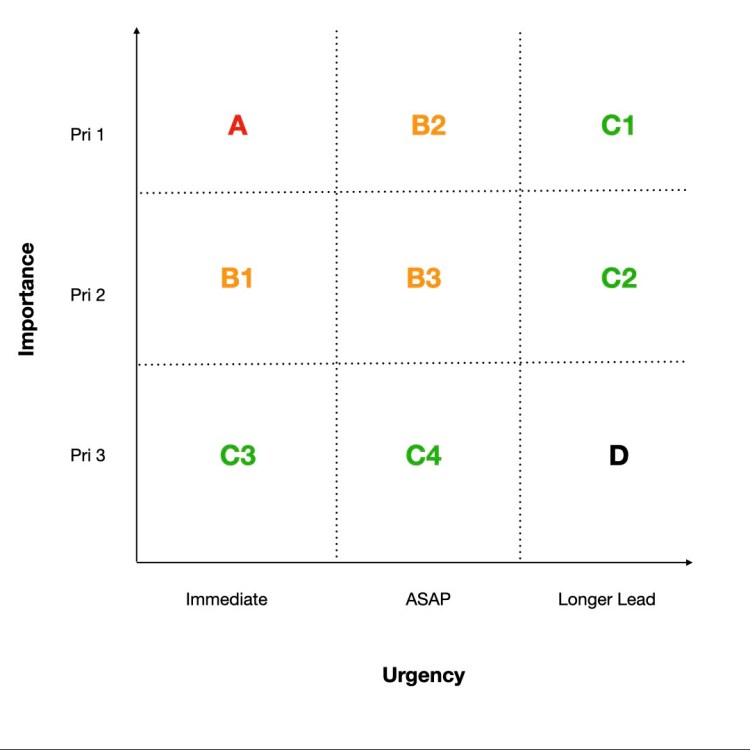
This is how I define importance and urgency:
- Importance: How important is the completion of this task? This may be defined by an external agency (the tasker), so I use the following:
- Priority 1 – Directed task with a ‘no fail’ criteria and high consequences if not completed.
- Priority 2
- Requested by a higher authority, or
- an internally identified task, or
- an interim or enabling element to a larger task.
- Priority 3 – ‘Nice to Do’ or of low consequence
- Urgency: How quickly does the task need to be completed? This is usually part of the task. The urgency differentiator is dependant on the responsiveness you need to meet. For me, my tasks usually work in the weeks timeframe.
- Immediate – for me, anything due in the next 2 business days is considered ‘immediate’.
- ASAP – within the next 2 weeks constitutes ‘as soon as possible’.
- Longer lead – for those tasks which are due for a while, however when you invest in these tasks the outcomes are more beneficial.
By allocating the A through D priority to each task you will be able to quickly see which tasks should have your attention. Similarly, a less-important task due in 2 days should be done before the no-fail task due in the next 2 weeks.
This approach also fits nicely with most task tracking applications, be it the native task tracker included in Microsoft Outlook or the bespoke tracker, or even the hand-written To Do list in the diary. Most electronic task trackers have 3 priority levels, which neatly fit with this approach: A – High; B – Normal; and C/D – Low. Labelling becomes important when you filter/order the tasks, because if you filter alphabetically and label the task with the priority at the beginning then the B1 tasks will appear before B2 etc.
It is essential to review the list regularly and update the priority as the deadline approaches. As you can see from the matrix, once the ‘Urgency’ column changes the priority jumps markedly. Part of my daily routine, at the start and end of each day is to review my task list and update the priority if the due date now falls within a shorter timeframe.
This is what it looks like in practice:
- An important task to complete a report comes in to your in tray on Monday, due the following Friday. It is ‘no fail’ from the Boss, so it gets a priority of ‘B2‘ and is put into the task list.
- Another important task comes in on Monday afternoon to prepare the directorate budget for next year. It isn’t due for a month, so it gets a priority of ‘C1‘ and is put into the task list. You put time in the calendar for Tuesday afternoon to plan this task.
- During your planning session on Tuesday afternoon you identify a number of sub-tasks to the budget task. One of these tasks is to send out a request to section heads for their budget submissions, which needs to go out by Monday next week. As a sub-task which is due within the next 2 weeks, it gets a priority of ‘B3‘ for the task list.
- Thursday afternoon, as you review the Task List, the B3 task due next Monday is now due in 2 business days. It is re-allocated as ‘B1‘ and goes to the top of the list.
- On Wednesday of the second week, when you review the tasks, the ‘B2’ task due Friday is now due in 2 days so is re-allocated as ‘A‘.
The key things with this approach to task prioritisation are that you apply an objective set of rules to what you are doing to identify what to spend your time on. It takes into consideration the importance of deadline proximity and is dynamic, but does require you to invest regular time to keep the list accurate.
 Matthew Harvey
One thought on “Task Prioritisation”